The Expo 2025 Osaka-Kansai brought dozens of countries together on the artificial island of Yumeshima under the theme Designing Future Society for Our Lives. For structural timber construction it was an exceptional showcase: Japan displayed its forestry chain, craft, and Sou Fujimoto's Grand Ring — Guinness World Record for the world's largest timber architectural structure. Colombia arrived with a narrative pavilion of translucent ice cubes. This article explains what the Expo was, why it matters, and what it left in architecture — including how Colombia's pavilion fared.
Guía informativa. Imágenes con crédito al fotógrafo o medio indicado. Vídeos embebidos desde YouTube.
What is Expo Osaka 2025?
The World Expo, regulated by the Bureau International des Expositions (BIE), originated with London's Great Exhibition of 1851. Conceived historically as the "Olympics of innovation, architecture, and diplomacy," it has been the stage where humanity first witnessed breakthroughs like electricity, television, X-rays, touchscreens, and even the ice cream cone. Monumental landmarks such as the Eiffel Tower in Paris or the Space Needle in Seattle were born precisely from these exhibitions. Osaka 2025 —Japan's third Expo after Osaka 1970 and Aichi 2005— took place on the artificial island of Yumeshima in Osaka Bay, from April 13 to October 13, 2025.
The official theme of this edition, Designing Future Society for Our Lives, did not just propose healthier, more connected societies, but functioned as a full-scale laboratory of urban sustainability. Just as the 1893 Chicago Expo built the "White City" powered entirely by electricity (setting the blueprint for modern metropolises), at Osaka 2025 dozens of countries raised temporary pavilions with a radical focus on circular economy, off-site rapid assembly, and planned dismantling.
Why it matters for architecture and timber
Expos are the ultimate barometer of global construction trends. In 1970, the historic Osaka Expo shocked the world with the Festival Plaza —a futuristic canopy supported by one of the largest space frames of the era, spanning 100 meters wide— and Taro Okamoto's surreal Tower of the Sun. At Expo 2010 in Shanghai, the scale became urban: 5 square kilometers were transformed and the massive red inverted pyramid China pavilion was built. For 2025, in a context marked by decarbonization, steel gave way to engineered timber and modular biogenic materials.
For mass timber professionals, Osaka 2025 was a turning point. Japan did not use wood as a simple aesthetic cladding, but as the primary load-bearing structure of the site entrance. The Land of the Rising Sun merged its millennial tradition of forestry carpentry —famous for its nail-free interlocking joints and sustainable forest management— with the most advanced 21st-century industrial prefabrication and 3D digital modeling technologies.
Japan: Grand Ring and record-scale mass timber
Grand Ring (The Ring) · Sou Fujimoto · Yumeshima
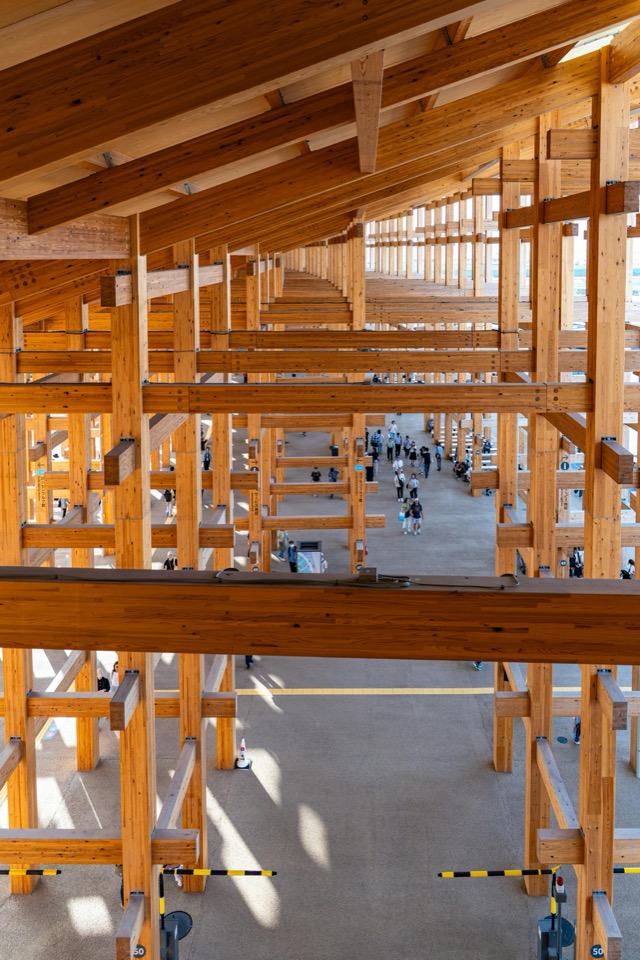
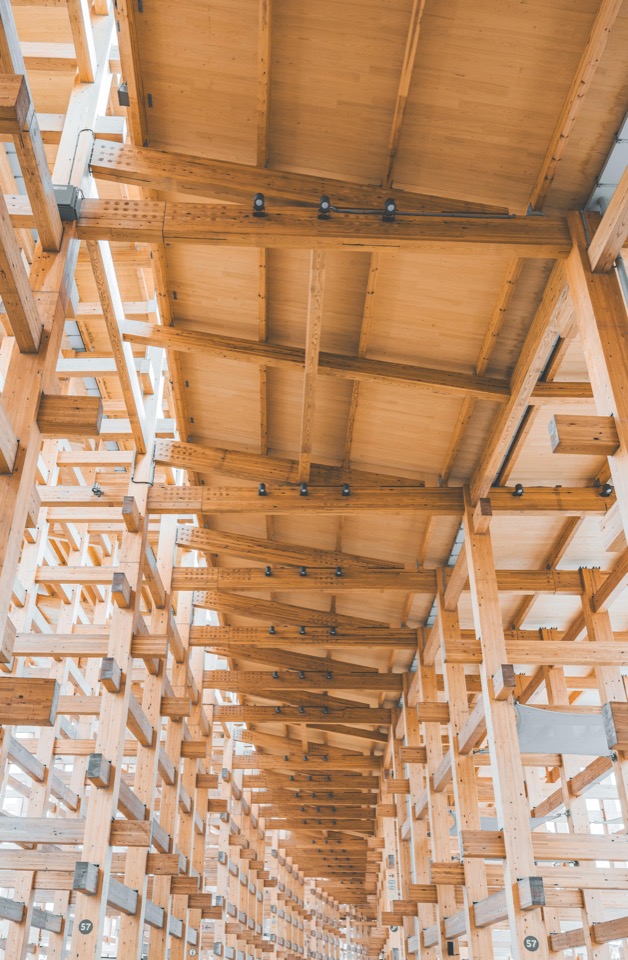
The spectacular ring by Sou Fujimoto was conceived as a "circle of unity" so that, when looking up, all visitors would see one single sky. With an estimated cost of 34.4 billion yen (around 240 million dollars), this structural mass timber crown has an inner diameter of 615 meters and an outer diameter of 675 meters, covering a surface area of over 61,000 square meters (equivalent to eight football fields). Spanning a 2-kilometer circumference and rising up to 20 meters high, Guinness World Records formally certified it in March 2025 as the **largest timber architectural structure on Earth**.
The structure required over 27,000 cubic meters of wood —enough to fill 10 Olympic pools or equivalent to the volume of 10,000 elephants—. If all that timber were laid out in standard 2x4s, it would stretch from Osaka all the way to Los Angeles. About 70% was high-strength, lightweight local Japanese cypress and cedar, and the rest Scots pine. A strategic portion was sourced from certified forests in **Fukushima** Prefecture, rebooting the regional forestry economy through a closed-loop supply chain (felling, milling, and laminating in situ). For assembly, the ancient **Nuki** technique was revived (horizontal beams interlocking through vertical posts), which allows structural wood to flex and dissipate seismic waves instead of resisting them —the same joint system that has kept Ise Jingu and Horyu-ji temples standing for over a thousand years. This was enhanced with 21st-century engineering: glued laminated timber (Glulam) and hidden steel connectors to satisfy modern seismic codes.
Circular planning and the ring's «afterlife»
The Japan Association for Expo 2025 committed to reusing materials «to the extent possible». After the Expo closed (13 October 2025), dismantling began in December. According ArchDaily, post-Expo management included:
- Permanent section: ~200 m of the ring remain at Yumeshima.
- Timber auction (Oct–Nov 2025) to match supply and demand for site materials.
- Confirmed destinations: reconstruction in Namie (Fukushima), a student building at Kansai University, and public housing in Suzu (Ishikawa).
Despite its spectacular nature, the project did not escape criticism. While a 25% wood reuse rate was initially planned, the actual confirmed rate was 12.5%, sparking debates on whether World Expos represent "genuine sustainability" or "disposable grandeur posing as green architecture." Even so, with massive beams over 400 mm thick prefabricated in factories and hoisted by crawler cranes like "Jenga on steroids," the assembly managed by Obayashi, Shimizu JV, and Takenaka completed a month ahead of schedule in August 2024. The logistical dismantling of the Grand Ring serves today as the most complex and documented circular economy case study in the mass timber sector.
Colombia at the Expo: the «Ice Cube» pavilion
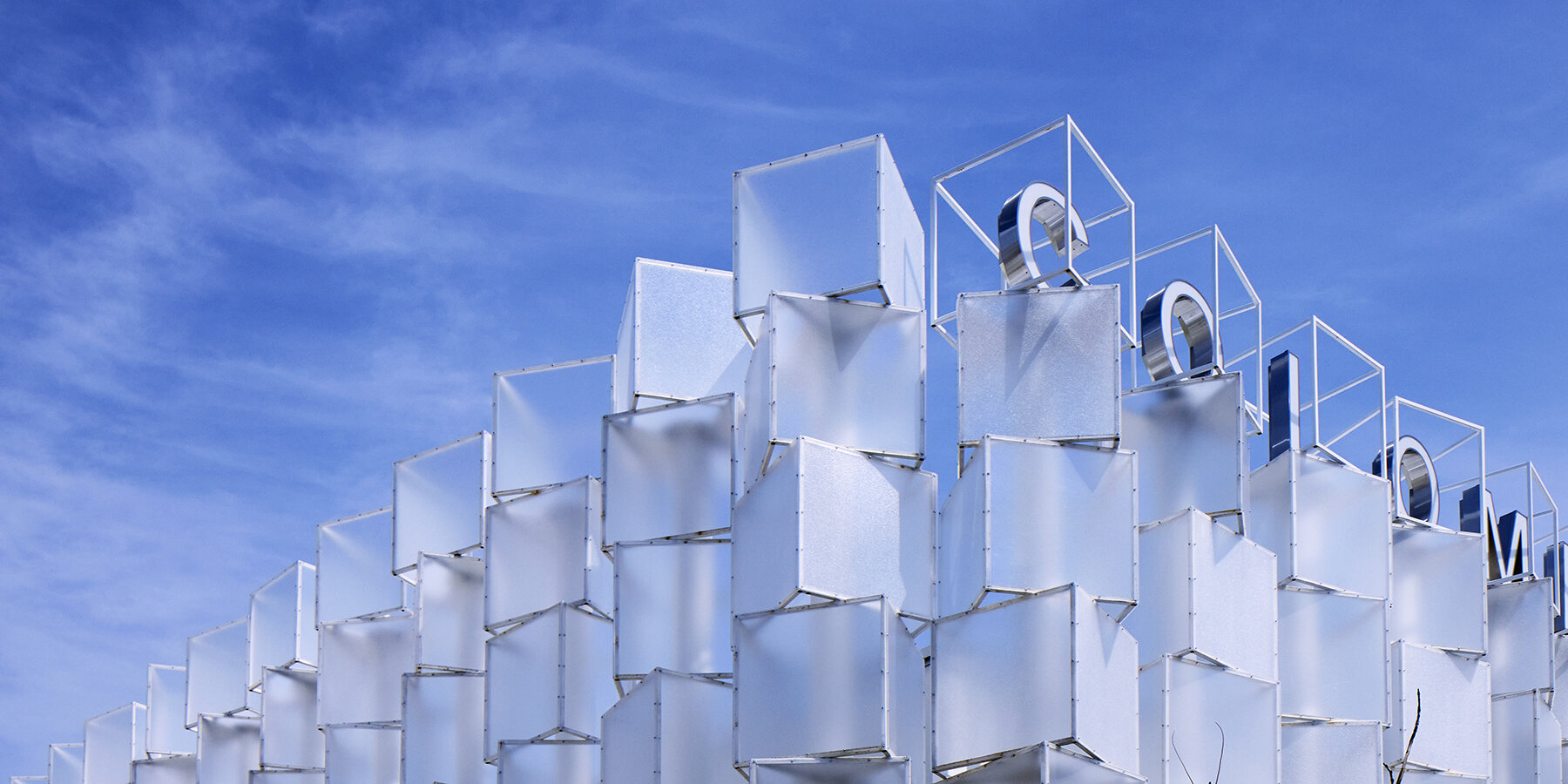
Under the «Ice Cube» concept and the premise of presenting Colombia as the country of beauty, the national pavilion at Osaka 2025 stood out with a modular, semi-transparent polycarbonate façade that dynamically played with light. Designed by the MORF team on floating foundations to adapt to the challenging clay soils of Yumeshima Island, the 584 m² structure was built using a lightweight prefabricated steel system expressly designed for easy dismantling, relocation, and subsequent reassembly.
Inside, a lobby featuring an origin coffee bar introduced visitors to a sensory journey, narratively guided by magical realism and Gabriel García Márquez's iconic yellow butterflies. Although not a structural mass timber project, the pavilion demonstrated a high standard of modular temporary architecture, construction assembly efficiency, and nation-brand storytelling. You can follow details of its journey on the official Instagram account @colombiaexpo or check out the proje ArchDaily.
This modular approach contrasts with the most important historical milestone of Colombian biogenic architecture in World Expos: the ZERI Pavilion at Expo Hanover 2000. Designed by architect Simón Vélez and constructed with Guadua (the Colombian «vegetal steel»), that decagonal circular pavilion spanning 40 meters in diameter demonstrated to the world the structural and seismic-resistant capacity of bamboo through joints injected with cement mortar. Today, that iconic work lives a definitive second life: it was dismantled in Germany, repatriated, and rebuilt in Manizales at the Recinto del Pensamiento, serving as the foundational example of circular wood and bamboo economy in our country.
Go deeper
- Great milestones in timber construction
- Mass timber overview (CLT, Glulam)
- Latin American timber projects
- How to measure sustainability in buildings: LCA
- Madebloque services
Madebloque informational edition — May 2026. Links and credits per cited public sources.