El Modelado de Información de Construcción (conocido por sus siglas en inglés como BIM, Building Information Modeling) no es simplemente hacer un render tridimensional atractivo; es estructurar un modelo digital compartido que contiene toda la información del proyecto.
En la industrialized mass timber construction, this prior agreement is what separates high-precision prefabrication from costly improvisation on site.
El arquitecto, el ingeniero calculista, el fabricante y el montador operan sobre el mismo edificio digital.
What is Building Information Modeling (BIM)?
To understand building information modeling, imagine it as the live digital record of the building. This centralized file unifies the geometry, material properties, delivery schedules, estimated costs, and responsibility assignments. It is not simply a software for three-dimensional drawing, but a collaborative work methodology.
The practical difference compared to traditional methods is radical:
- Traditional two-dimensional drawing (CAD): each discipline draws its plans in isolation. Spatial clashes are discovered late during actual construction.
- Flat three-dimensional model: useful for visual presentations and marketing, but lacks integrated technical metadata and information exchange rules.
- Coordinated information modeling (BIM): multiple authorized actors model and update synchronized databases, with clear rules for interoperability and traceability toward construction and operations.
This structured workflow allows us to move from conceptual visualization to digital fabrication protocols, ensuring project consistency from its early phases.
Why Structural Timber Demands a Change of Rules
In traditional concrete or brick construction, site teams usually tolerate a certain margin of improvisation; alignment errors are corrected by chipping walls or adding mortar. In structural mass timber projects, this flexibility completely disappears. Cross-laminated timber (CLT) panels and glued laminated timber (Glulam) beams are prefabricated according to the model dimensions and arrive ready for assembly.
Any subsequent modification at the job site is expensive, weakens the structure, and slows down the crane. Therefore, the design must be completely frozen and coordinated before fabrication begins. This includes the routing of mechanical, electrical, and plumbing systems (MEP systems), connection hardware, and dowel holes. The digital model is the tool that makes this rigorous planning viable.
Who Operates on the Digital Model?
The model does not belong to a single professional; it is a chessboard where multiple specialized disciplines converge:
- Architecture: defines the massing, spatial distribution, envelope design, and overall aesthetic coordination.
- Structural Engineering: calculates load-bearing elements, specifies timber grades, and designs high-resistance metallic connections.
- Fabrication and Workshop: extracts templates for robotic saws and defines the labeling of panels for shipping.
- Assembly and Logistics: simulates crane positions, swing radii, and plans the erection sequence piece by piece.
- Systems and Networks (MEP): routes ventilation ducts, electrical trays, and fire protection pipes to avoid collisions with the structure.
- Cost Control: performs automatic material takeoffs for procurement and financial flow estimates.
In hybrid structures combining timber with steel or concrete cores, precise digital coordination is the only way to guarantee that the millimeter tolerances of engineered timber fit with the wider tolerances of traditional structural work.
Levels of Development (LOD): Graphical and Informational Detail
The term Level of Development (LOD, Level of Development) is often misunderstood. It is essential to distinguish between its two core components:
- Level of Detail (Graphical detail): defines the visual complexity and geometric representation of an object.
- Level of Development (Informational detail): specifies the maturity of the metadata associated with the object (material strength, inventory code, vendor, approval status).
In structural mass timber projects, a common and highly expensive error is sending designs to fabrication with an insufficient level of development. Below are the standard levels defined in project management:
| Nivel LOD | Uso Recomendado y Alcance en Madera |
|---|---|
| LOD 100 | Conceptual: volumen general y masa del edificio sin especificación de materiales ni sistemas constructivos. |
| LOD 200–250 | Esquema básico: dimensiones preliminares de la estructura de madera y ubicación aproximada de los núcleos. |
| LOD 300 | Proyecto ejecutivo: geometría coordinada tridimensionalmente; los paneles tienen espesores definidos pero faltan detalles finos de conexiones. |
| LOD 400 | Fabricación: incluye todos los cortes CNC, perforaciones de tornillos, rebajes para conectores y especificaciones de taller listas para producción. |
| LOD 500 | As-built (Como construido): modelo verificado en obra con sensores de humedad y cambios en sitio, útil para la gestión de activos y operación. |
For an industrial plant to machine a cross-laminated timber panel, it requires the model to reach a LOD 400 development level. This requires all engineering disciplines to approve the building layout before the timber
The BIM Execution Plan (BEP): The Contractual Rules of the Game
The BIM Execution Plan (known as BEP, BIM Execution Plan) is the contractual document that establishes the project's working guidelines. Without this structured plan, the term «coordinated model» is left to the free interpretation of each subcontractor, generating chaos in data integration.
The plan must explicitly resolve the following operational questions:
- Modeling protocols: what measurement units will be used and how will the structure of levels and georeferenced coordinates be organized?
- Responsibility matrix: who is the author of each element in each phase and who approves design changes?
- Exchange formats: how will files be exported to guarantee interoperability (open formats like IFC or direct connectors)?
- Quality control and versioning: what is the official channel for reporting clashes and validating that the as-built model matches reality?
Preconstruction: Coordinating Before Cutting
Digital preconstruction is the phase where the BIM methodology generates the highest return on investment. Critical activities in this phase include:
- Clash Detection: automated algorithms cross the timber structure with the MEP layouts, detecting early if a ventilation duct crosses a structural beam.
- Erection sequence (4D): linking the construction schedule with the digital model to simulate the arrival and assembly order of each panel, reducing crane downtime.
- Traceability and logistics: assigning unique codes to each structural mass timber panel to control its factory production, transport, and assembly.
- Environmental risk management: planning on-site storage and protection of wood against weather conditions during construction.
- Systems matrix: structuring the model into master files by floor and discipline to optimize computer system performance and facilitate coordinated two-dimensional drawing reviews.
Concrete Benefits for the Project
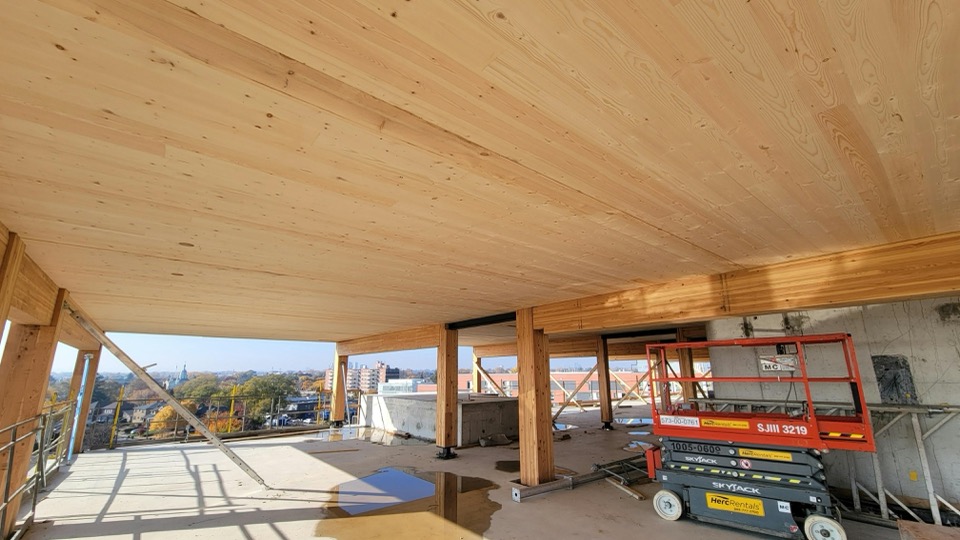
- Workshop precision: files exported from the LOD 400 model directly feed the robotic saws, eliminating material waste and improvised on-site adjustments.
- Reduced cost of changes: resolving clashes on a computer screen costs a fraction of what it takes to correct a structural error once construction is underway.
- Centralized information: immediate access to precise quantities, facilitating financial decision-making and bulk purchasing.
- Automated life cycle assessment: wood and concrete volumes extracted from the model directly feed embodied carbon calculations (as explained in our guide on building carbon regulations).
Specific Considerations for Structural Timber
Although general BIM principles apply to any material, engineered wood introduces unique particularities that must be incorporated into the models:
- Connection granularity: metallic joints, structural screws, and dowels must be modeled precisely to avoid physical clashes during site assembly.
- Pre-planned MEP penetrations: pipe and large-diameter duct pass-throughs in CLT panels must be defined in the model before CNC cutting, as subsequent manual drilling can compromise slab stiffness.
- Structural moisture monitoring: integration of physical moisture sensors within the structural mass timber panels during assembly; drying data must be recorded within the asset metadata.
- Hybrid interface modeling: clear definition of connections between structural timber and concrete foundations, controlling accumulated mechanical tolerances.
- Sustainability parameters: associating Environmental Product Declaration (EPD) sheets with the geometric elements of the model to audit the carbon footprint.
Communication and Document Management Scenarios
The BIM Execution Plan must govern communications between parties through standardized workflows for the following scenarios:
- Change control and revisions: electronic logging of all design modifications with responsible parties and dates.
- Three-dimensional collision detection: clash reports in agile formats that guide discipline coordinators.
- Certification and physical site progress: linking assembly progress to the digital twin to generate visual reports.
- Quantity takeoffs and measurements: parameterized extraction of materials to validate vendor invoices.
- Exchange of coordinated two-dimensional drawings: ordered export of erection drawings ready for site crews.
- As-built model handover for operations: transferring the final digital model enriched with maintenance manuals and equipment warranties.
For technical teams seeking to break down traditional software silos, open data platforms like Speckle are the perfect complement to the BEP. These tools allow granular versioning of geometry and connect it directly to enterprise accounting and ERP systems like Odoo, facilitating continuous project auditing.
Operational Challenges in Implementation
- Technical skills gap: the intersection between mass timber engineering and advanced modeling demands specialized training for the design team.
- Real interoperability: ensuring that information flows without loss between architectural design, structural engineering, and CNC manufacturing software using open standard formats like IFC.
- Ownership and intellectual property: contractually regulating digital model ownership and usage rights to avoid legal disputes at project close.
- Hybrid tolerance management: planning the necessary connections and mechanical clearances to couple millimetric prefabrication with traditional on-site construc
Conclusion
Building Information Modeling (BIM) is not merely an optional delivery requirement; it is the backbone that makes industrialized timber construction viable and efficient. By establishing coordinated three-dimensional models, appropriate levels of development, and structured communication flows, builders eliminate improvisation and maximize the potential of digital prefabrication, ensuring faster, more profitable, and highly sustainable projects.
Go Deeper
- Structural mass timber overview (CLT, Glulam)
- Data tracking on site: Odoo, Speckle, lean, and IoT
- Building carbon regulations and biogenic storage
- Madebloque services and engineering
Selected Bibliography
- Waugh Thistleton Architects, Elliott Wood, OFR Consultants & Lignum Risk Partners (2024). Commercial Timber Guidebook (G-0011). Sector consensus guide on timber design.
- WoodWorks — Wood Products Council (2024). Mass Timber Design Manual, Volume 2. Technical preconstruction and modeling guidelines.
- University of Utah, Integrated Technology in Architecture Center (2020). Mass timber — evaluating construction performance. Empirical assessment of preconstruction and assembly duratio
- buildingSMART International (2023). BIM and structural timber coordination guidelines using IFC standards.
Reference Documents and Technical Links
- Preconstruction BIM Protocols: modeling guidelines, LOD, actors, and scenarios (Madebloque internal reference document)
- Technical timber design guide: woodworks.org · Design manual and CNC tolerances
- Empirical performance study (University of Utah): detailed schedule analysis of mass timber prefabrication and erection
- Open data platform: speckle.systems · Connectivity and versioning of BIM models for ERP
Madebloque informational edition — May 2026. Based on standards from buildingSMART, CTG (2024), and digital preconstruction literature.